

Is recycling always the greener choice? Most of us would say yes without thinking twice. But recycling is not magic. Trucks collect the waste, machines sort it, and factories clean and melt it. All of that uses energy and costs money. Life cycle assessment is a way to check, honestly, whether a recycling route is really worth it. In this article, we explain what it is in plain words, and how MoeBIOS uses it.
A simple example: one yoghurt pot
Imagine an empty yoghurt pot made from a plant-based plastic. You rinse it and put it in the right bin. What happens next?
A truck drives through your street to collect it. At a sorting plant, conveyor belts and sensors pick it out from everything else. Then it travels to a recycling plant. There it is washed, shredded and melted, or broken down with heat or chemicals. Finally, the material becomes something new.
Every one of those steps has a cost. The truck burns fuel. The sensors and belts run on electricity. Washing uses water. Melting needs heat. So “it got recycled” is only half the story. The other half is: what did it take to recycle it?
What is life cycle assessment?
Life cycle assessment, or LCA for short, is a method that adds up the environmental impact of a product or a process from start to finish. Experts often call this “from cradle to grave”.
Think of it as a very careful receipt for the planet. Instead of prices, the receipt lists things like energy used, water used, raw materials used and greenhouse gases released. It covers every stage: where the material comes from, how it is made, how it is used and what happens at the end.
The method follows international rules, set out in the standard ISO 14040. This matters, because it means different studies count things in the same way. In Europe, the European Commission’s Joint Research Centre runs the European Platform on LCA, which shares common methods and data.
Why do we need it?
Because our instincts can be wrong. A process that looks clean might use a lot of energy behind the scenes. A material that sounds “green” might travel thousands of kilometres before it is used.
Life cycle assessment shows where the biggest impacts really are. Sometimes they sit in a place nobody expected, such as the transport, or the cleaning step. Once you know where the problem is, you know what to improve first.
And what is life cycle costing?
Life cycle assessment has a twin called life cycle costing, or LCC. It follows the same steps, but it counts money instead of environmental impact.
Here is a familiar comparison. When you buy a car, the price in the showroom is not the full cost. You also pay for fuel, insurance and repairs for years. Life cycle costing does the same for a recycling plant. It counts the cost of buying the machines, and then the cost of running them every day: energy, staff, maintenance and so on.
Two questions, one life cycle
So the two methods look at the same journey with two different questions. Life cycle assessment asks: what does this cost the planet? Life cycle costing asks: what does this cost in money?
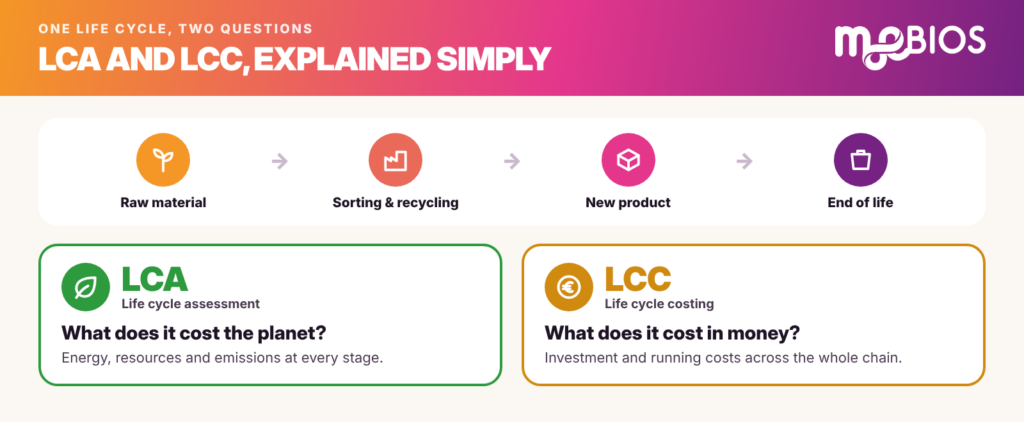
You need both answers. A recycling route that is very clean but far too expensive will never be used by real companies. A cheap route with a heavy environmental footprint misses the whole point of recycling. The goal is to find routes that make sense on both counts.
How life cycle assessment works in MoeBIOS
In MoeBIOS, this work is led by our partner ZER0-E, as part of the project’s sustainability assessment work. It happens in three steps.
First, the team collects information from the partners who sort and recycle bioplastic waste. How much material goes in and comes out? How much can each machine handle? How much energy does it use? What does it cost?
Second, they turn that information into computer models. You can think of a model as a digital recipe for each recycling route. It describes every step and lets the team test “what if” questions without building anything new. What if the plant runs at full capacity? What if energy prices go up?
Third, the models feed the life cycle assessment and the life cycle costing. ZER0-E started with the packaging value chain, including mechanical recycling, where plastic is cleaned, shredded and melted without changing its chemistry. In June, the team submitted the project’s first report on process modelling.
“One of the most interesting challenges in MoeBIOS is bringing together data from different partners and recycling processes in a consistent assessment framework,” says Johann Ramirez from ZER0-E. In simple terms: every partner measures things a bit differently, and the team has to make all of it fit together.
From numbers to better decisions
All this work leads somewhere practical. The results will feed the MoeBIOS Decision Support System, a digital tool for waste managers. The idea is simple: help the people who run waste plants compare recycling routes, using environmental, economic and social information side by side.
It also connects to what we learn elsewhere in the project. For example, there are still very few bioplastics in real waste streams. That affects how much material a plant can process, and so its costs. And at our October webinars, people from industry kept asking about price and performance. Life cycle costing is built to answer exactly that kind of question.
What comes next
There are no numbers to share yet, and that is on purpose. ZER0-E is still filling data gaps with partners and checking that the models are reliable. Publishing early figures that later change would not help anyone. Public results will appear on our deliverables page as they become available.
In the meantime, if you are curious about how the cost of recycling reaches the products we buy, read our article on EPR fees for bioplastics. And follow MoeBIOS on LinkedIn for the next update.