

Would you buy a product made from recycled bioplastics? Before most people answer, they have questions. Is there enough material? Does it work as well? Does it cost more? On 14 October, MoeBIOS put these questions to the people who would actually use recycled bioplastics in their work.
Why we asked the people who would use recycled bioplastics
Recycling technology is only one part of the story. A recycled material also needs someone who wants to buy it, process it and put it on the market. If farmers, textile makers or packaging producers do not trust it, it stays in the lab.
That is why MoeBIOS works with the whole value chain, not only with researchers. We wanted to hear directly from the sectors we work for, before the results are final.
Three sessions, one question
Under the title “Are Recycled Bioplastics the Future? Have Your Say!”, we ran three online sessions on the same day. Each one focused on a different sector: agriculture, textiles and packaging.
Euro-Funding organised the sessions together with European Bioplastics and technical partners from our consortium. Participants did more than listen. They answered live surveys about what would make them trust a recycled bioplastic.
The worries every sector shared
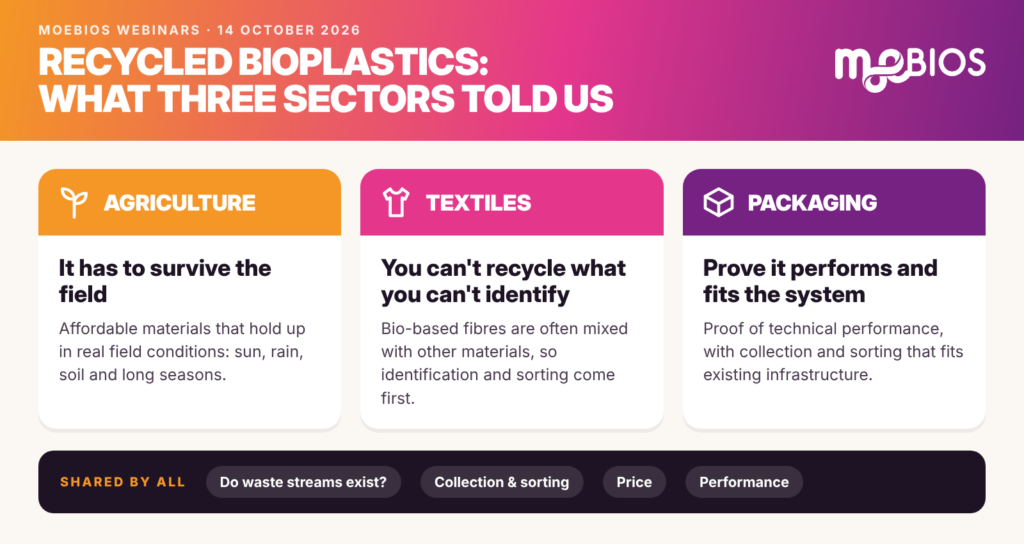
The answers differed by sector, but four concerns came up in every session. First, do suitable waste streams exist at all? Second, how do you collect and sort them? Third, can the recycled material compete on price? And fourth, does it perform as well as the material it replaces?
None of these questions is new. Hearing them from three very different industries, though, shows how closely they are linked. A good material is not enough if nobody can collect it or afford it.
Agriculture: it has to survive the field
Participants from agriculture asked for materials that are affordable and hold up in real field conditions. Sun, rain, soil and long seasons put plastics under heavy stress. For a farmer, a recycled material that fails halfway through a season is not an option, however green it sounds.
Textiles: you cannot recycle what you cannot identify
The textile session pointed to a harder starting point. Bio-based fibres are often mixed with other materials, and they can be difficult to recognise. You cannot recycle what you cannot identify and sort. For this sector, the first challenge comes before recycling even begins.
Packaging: prove it performs and fits the system
The packaging session wanted proof of technical performance. Participants also asked for collection and sorting that fits the infrastructure Europe already has. A new material that needs a whole new system is a hard sell. Cost matters here too, which is why recycling fees are part of the conversation, as we explained in our article on EPR fees for bioplastics.
Early signals, not a verdict
These answers come from the people who joined our sessions. They are early signals, not a verdict on whole industries. Still, they make one thing clear: a recycling technology is only half the job. The other half is a value chain where material producers, waste managers, recyclers and brands trust each other.
These insights feed into MoeBIOS’s ongoing work with external stakeholders. They help us check that what we develop answers real needs. You can already read our earlier public findings on waste streams in deliverable D1.3.
Thank you, and let’s keep talking
Thank you to everyone who joined and shared their views. If you missed the sessions, you can still join the conversation: follow MoeBIOS on LinkedIn, or start with our explainer on biodegradable vs recyclable bioplastics. The questions are open, and we want to hear from you.